The Craft Behind the Cloth: What Makes Handcrafted Embroidery Different
Most people cannot immediately tell the difference between machine embroidery and handcrafted work when they see it on a hanger. But the moment they put it on, they understand. The weight is different. The texture is different. The way it moves against the body is entirely different.
At Indigrey, every piece we make is the result of a craft process built around attention to detail at every stage. Here is what that process actually involves.
It Starts With a Motif, Not a Template
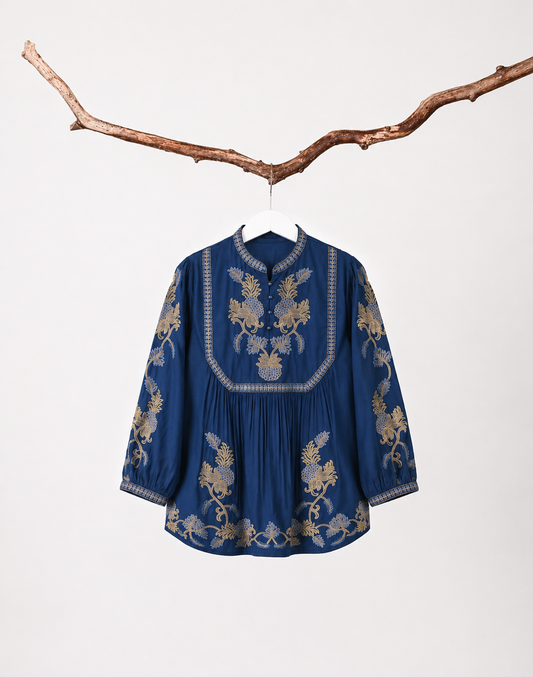
At Indigrey, each motif is created specifically for the piece it belongs to. We start from the character of the silhouette — its weight, its drape, the kind of woman who will wear it and where — and we design the motif to serve that silhouette. A piece that is meant to feel light and effortless gets a motif with openness and movement built into it. A more structured piece gets something denser and more precise.
This means every design takes longer. We think that is exactly how it should be.
The Stitch Is Not an Afterthought
Once a motif is designed, the next decision is which stitch to use to fill and outline it. This is a step that demands real time and expertise.
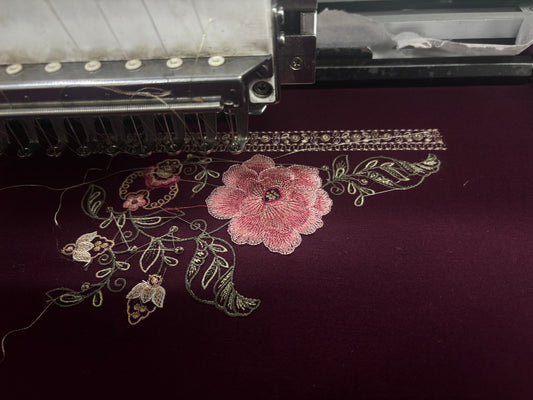
Different stitches produce entirely different surfaces. Sketchfill Cord creates a soft, slightly raised texture that catches light gently. Knotwork embroidery produces a more tactile, dimensional surface — you can feel it with your fingertips. Filigree Traceline is precise and delicate, creating fine lines that read almost like illustration. Pixel Cross Stitch builds texture from tiny repeated units, creating a mosaic-like quality that becomes visible up close.
Each of these is chosen because it is right for that specific motif on that specific piece. The stitch is the difference between embroidery that looks finished and embroidery that feels finished.
Thread Colour: The Part That Is Hardest to Get Right
Thread colour is where the craft either comes together or quietly falls apart.
The instinct is to use contrast — to make the embroidery visible and dramatic against the base fabric. But contrast without calibration produces embroidery that fights with the garment rather than completing it.
What we do instead is build colour combinations that are harmonious — where the thread colours relate to the base fabric, to each other, and to the overall mood of the piece. A wine-coloured top might carry embroidery in three or four tones of red, copper, and deep brown, each one chosen because of how it sits against the specific dye of that fabric in that batch.
Every combination is tested multiple times. We sample it, look at it in natural light, photograph it, change the thread ratios, and sample again. It is the slowest part of the process and the part we are least willing to rush.
What You Can Actually See and Feel
When you hold an Indigrey piece, a few things are immediately apparent. The embroidery does not pucker the fabric beneath it — a sign of correct thread tension maintained consistently across the piece. The edges of motifs are clean, not fraying or loose. The thread has a sheen that comes from the viscose content — warm and natural in its reflection.
And when you put the piece on, the embroidered sections do not feel stiff or heavy against the skin. The fabric underneath moves as it should. The embroidery sits on top of that movement rather than restricting it.
These are not accidents. They are the result of craft that has been practised, refined, and held to a standard that does not change batch to batch.
Why We Keep the Range Small
A common question we receive is why Indigrey does not have more designs. The answer is simple: because doing this properly takes time, and time is finite.
Every design in our collection has gone through the full process described above. Motif development, stitch selection, colour testing, sampling, revision, approval. Releasing more designs would mean compressing that process. We are not willing to do that.
What we offer instead is a smaller number of pieces that we stand behind completely — pieces where the craft is not a selling point but an actual fact, verifiable the moment you pick one up.
We think that is worth more.